
Is My Child Bored— Or Do They Need a Different School?
Every morning, it’s the same battle
Your child drags their feet, complains of a stomachache, or just stares blankly at the door before school like they’re walking into something they dread. You keep telling yourself, “it’s just a phase.” But you know in your heart of hearts a quiet voice is asking “what if this isn’t?”
If you’re a parent in Tyler, TX wondering whether your elementary aged child is simply going through a rough patch, or genuinely needs a different kind of school this is for you.
Not sure if House of Emet is the right fit? That's exactly what the first conversation is for. 👉 Schedule a free parent conversation — no commitment, just clarity.
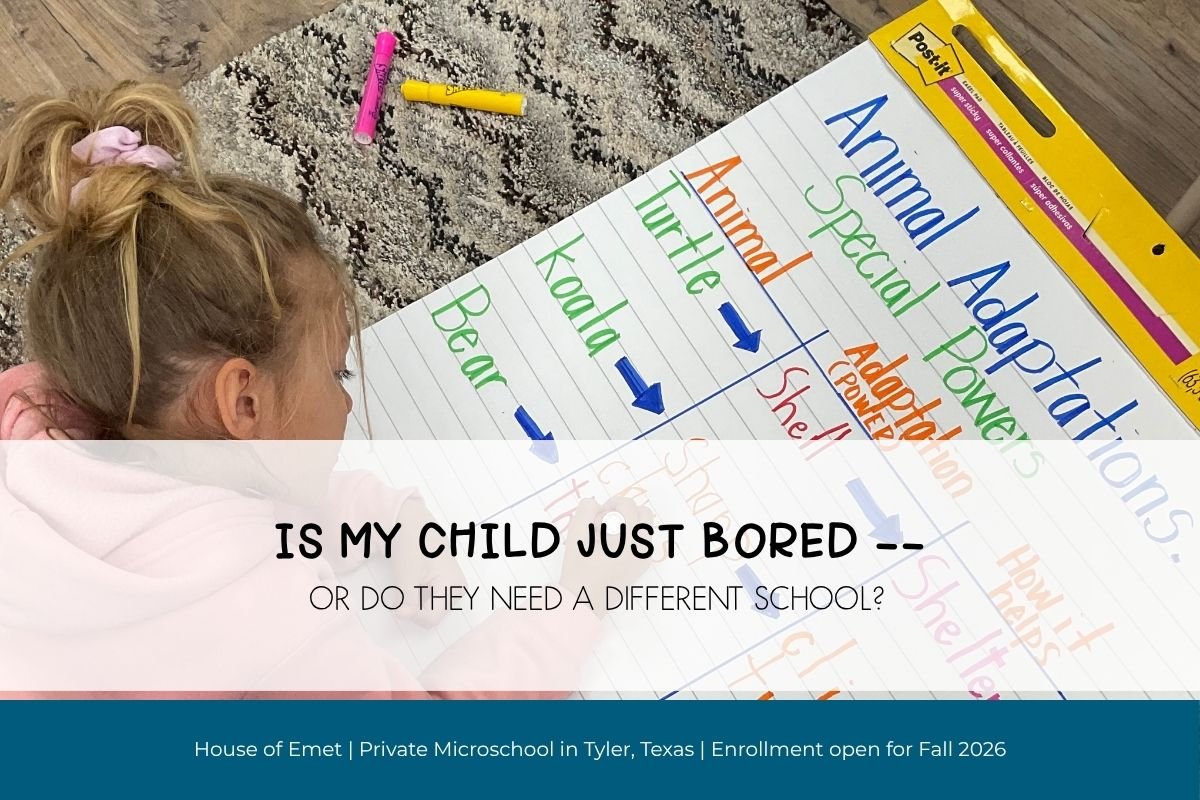
At House of Emet, every lesson is hands-on and built around curiosity— not a one sized fits all worksheet.
The difference between a rough patch and Real Mismatch
Kids have hard weeks. Teachers change, friends move, and some subjects click better than other. That’s normal.
There’s a big difference between a child that is temporarily struggling and a child who is consistently, quietly failing to thrive in their learning environment. Here’s what that often looks like:
Signs it might be a rough patch:
Reluctance started after a certain event (new teacher, friendship conflict, family change)
Your child can name what’s bothering them
They still have good days mixed in with hard ones
Their grades and confidence remain stable
Signs it maybe a deeper mismatch
Persistent anxiety or dread around school — not just Mondays
They’ve stopped talking about school or what they’re learning
Teachers describe them as “distracted”, “behind'“, or “not working to their potential.”
They once were curious and enthusiastic now that child has seem to have disappeared.
They frequently say things like “I’m dumb” or “I can’t do anything right”
Stomachaches, headaches, or meltdowns only happen on school days.
If that second list sounds all too familiar, it might be time to ask the harder question: Is this school environment actually build for my child?
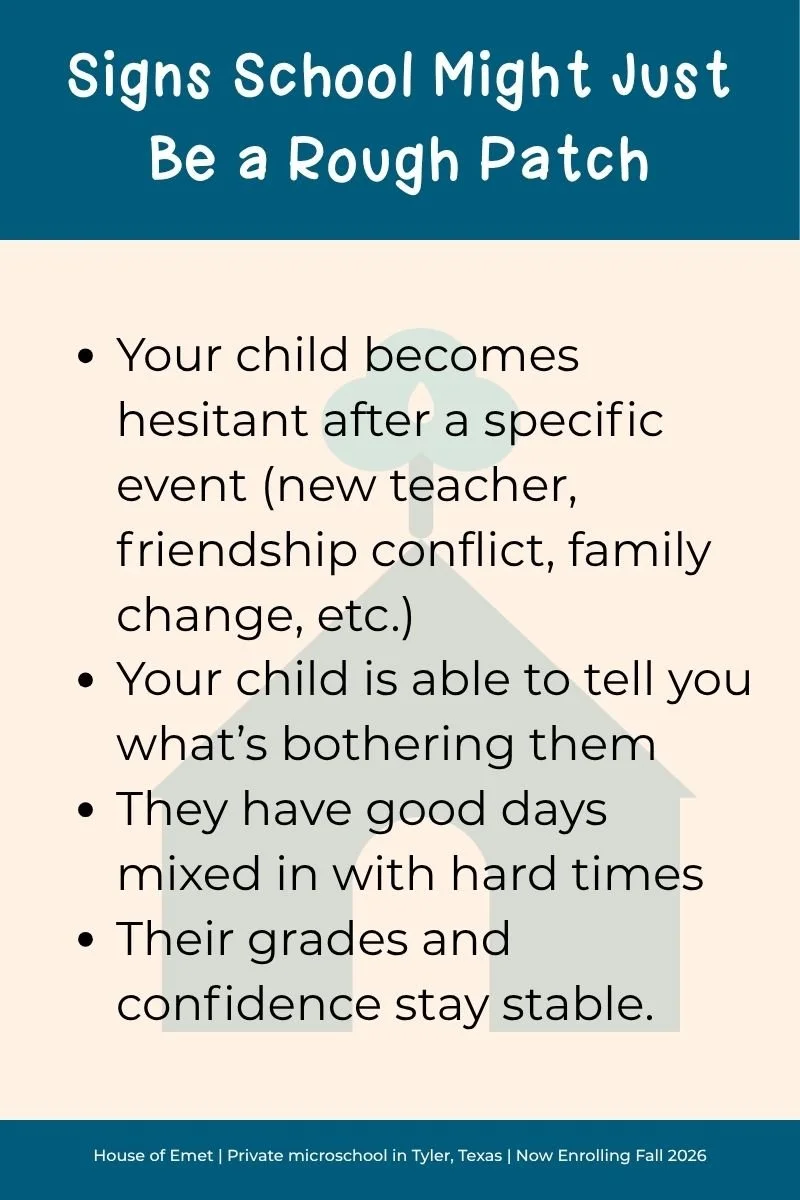
Not every hard season means the wrong school. Here’s how to tell the difference.
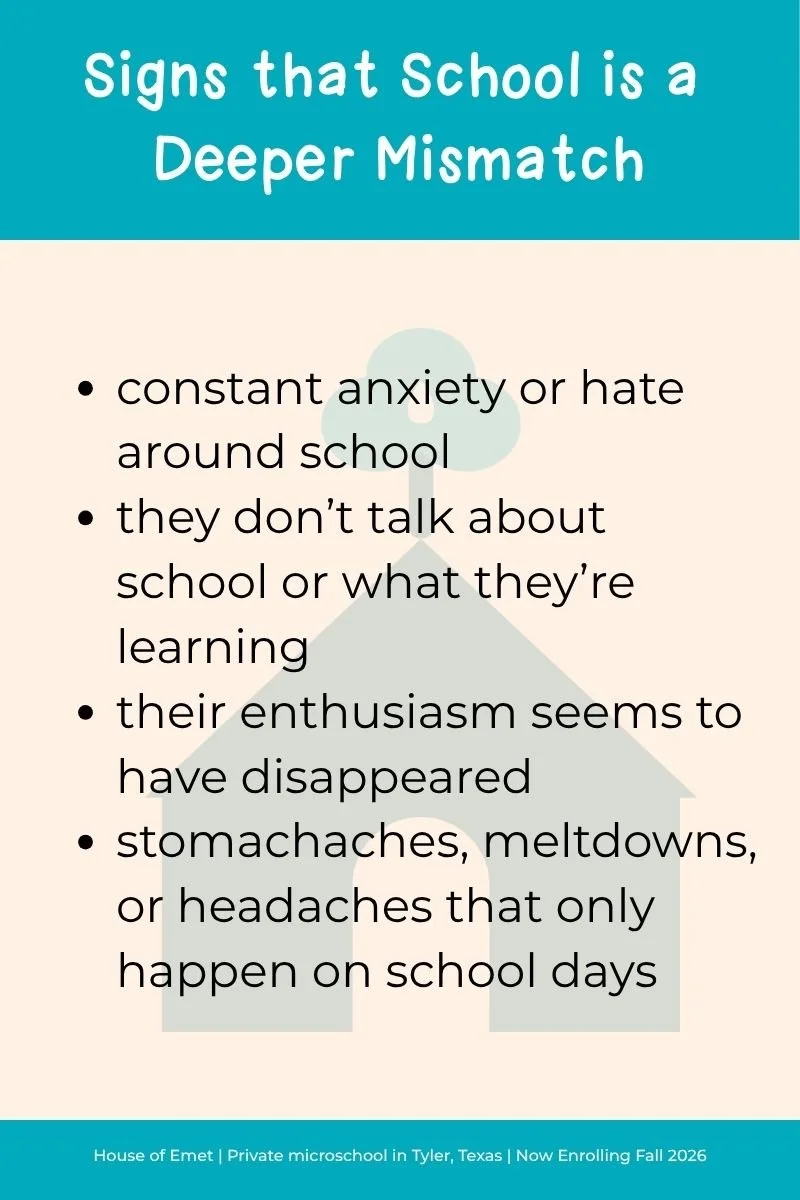
When the signs are consistent — not occasional — it not be a rough patch at all.
Why Traditional Classrooms Fail Capable Kids
Here's something that doesn't get said enough: a child can be completely capable and still not thrive in a traditional school setting.
Most public and traditional private schools are designed for efficiency — large groups, standardized pacing, and a single instructional approach. For many kids, that works fine. For others, it's like being handed shoes that are two sizes off. The shoes aren't broken. The child isn't broken. They just don't fit.
Children who often struggle in traditional classrooms include:
Kids who process differently — they need more time, more movement, or a different explanation style
Kids who are academically behind in one area — when the class moves on and they're still catching up, the gap widens and the shame deepens
Kids who are sensitive to noise, transitions, or social dynamics — large classrooms are loud, chaotic places that drain some children before the learning even starts
Kids who are actually ahead — boredom looks a lot like disengagement, and disengagement often gets labeled as a behavior problem
None of these kids need to be "fixed." They need a better fit.
What a Better Fit Looks Like
A smaller, more intentional learning environment changes things in ways that are hard to overstate.
When a teacher genuinely knows your child — not just their reading level, but what makes them light up, what makes them shut down, and where they're quietly struggling — everything shifts. Instruction becomes personal. Gaps get addressed before they become crises. A child who spent years believing they were "bad at school" discovers that the problem was never them.
That's not a theory. That's what we hear from parents at House of Emet in Tyler, TX, time and again.
If this sounds like your child, we'd love to hear your story. 👉 Schedule a free parent conversation — it starts with listening, not selling.
Questions Worth Ask Yourself
Before you dismiss that quiet voice in the back of your head, sit with these questions:
When was the last time my child came home excited about something they learned?
Does my child feel known at their school — not just enrolled?
Are we addressing the same academic gaps year after year with no real progress?
Is my child's self-confidence growing or shrinking as they move through school?
There are no right or wrong answers here. But honest answers can tell you a lot.
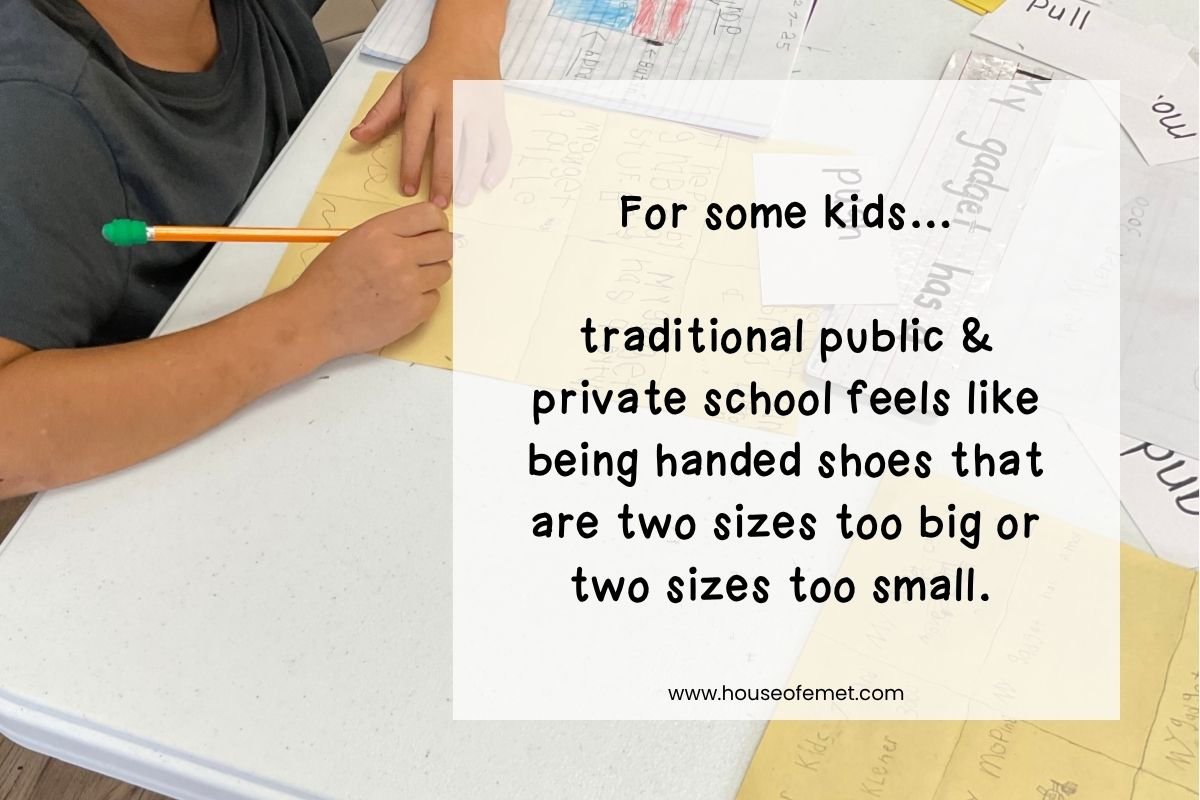
Some kids aren’t struggling because they are behind. They’re struggling because the environment was never built for them.
You Don’t Have to Decide Today
If any of this resonated, the next step doesn't have to be a big one. At House of Emet, we start with a relaxed parent conversation — no pressure, no commitment, just a chance to talk through what you're seeing and whether our environment might be a good fit.
We're a K–5 microschool in Tyler, TX serving 8–10 students per class. We're WASC and TEPSAC accredited and accepted under Texas's TEFA program, which means many families can use state education funds to cover tuition.
If your child is capable but not thriving, we'd love to talk.
👉 Schedule a free parent conversation — it starts with listening, not selling.
