
TEFA in Texas: A Clear, Parent-Friendly Guide from an Educator
If you’ve recently searched “TEFA Texas,” “TEFA funds,” or “TEFA eligibility,” you’re not alone.
Many Texas families are hearing about the Texas Education Freedom Account (TEFA) and trying to understand what it actually means for their child, their school options, and their family decisions. Unfortunately, most of what’s online either feels overly technical or leaves parents with more questions than answers.
So let’s slow this down and talk through TEFA clearly, calmly, and without the noise.
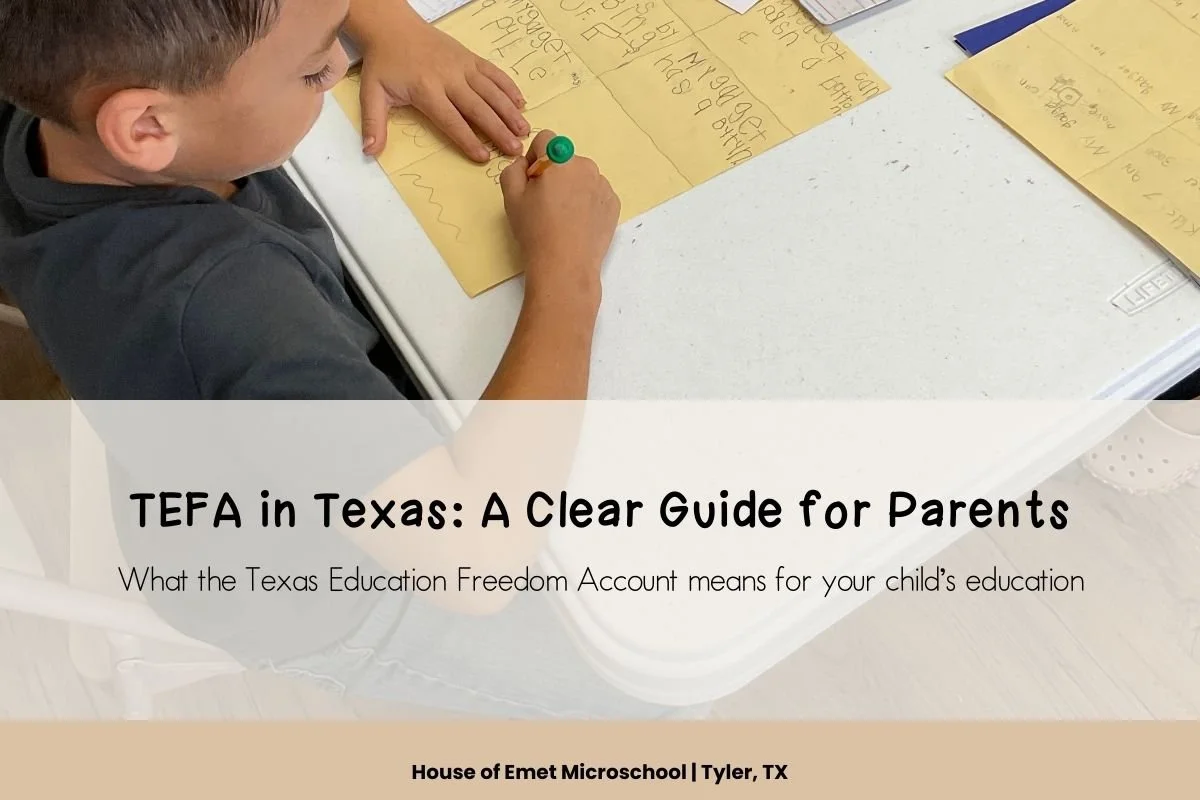
Understanding TEFA in Texas and what it means for families exploring education options.
What Is the TEFA Program in Texas?
TEFA stands for Texas Education Freedom Account.
At its core, TEFA is designed to give families more flexibility in how education funds are used—particularly when a traditional, large-scale school setting may not be the best fit for a child.
Instead of education dollars being tied to a single system, TEFA allows eligible families to use approved funds for qualifying educational options such as:
private schools
microschools
learning centers
tutoring
curriculum
educational assessments
The goal is not to remove structure or accountability, but to expand the types of learning environments families can access.
Is TEFA the Same as a Voucher?
This is one of the most common questions parents ask.
TEFA is not a traditional voucher program.
Vouchers typically send money directly to schools. TEFA funds are usually managed through approved platforms and may only be used for specific, eligible educational expenses.
This structure exists to:
ensure funds are used for education
provide oversight
protect families and students
TEFA offers flexibility—but within clear guidelines.
Who Is Eligible for TEFA Funds?
Eligibility details depend on the state’s final rollout, but TEFA is generally designed to support families who are:
currently enrolled in public school
seeking alternative education options
navigating specific learning needs
exploring smaller or more personalized learning environments
Homeschool families may also be eligible, depending on how funds are used and whether services qualify as approved educational expenses.
This is where understanding how education is delivered becomes important.
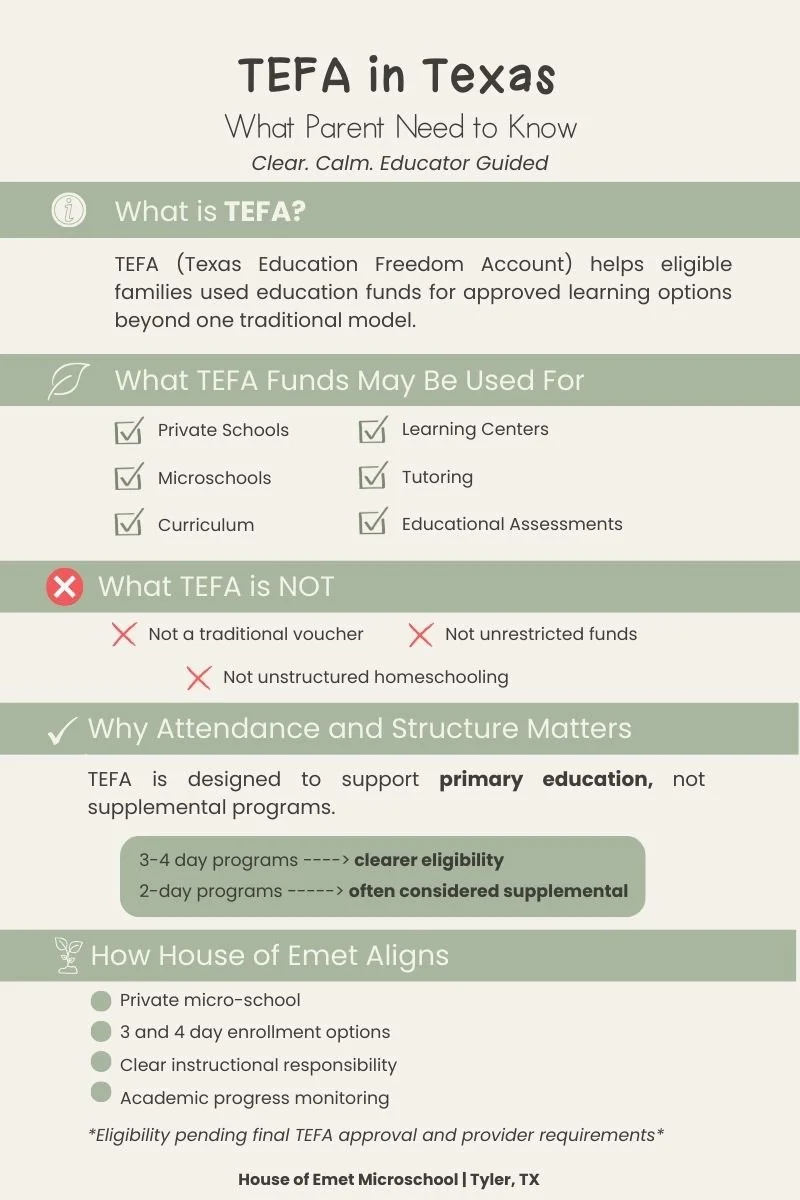
A simple breakdown of TEFA in Texas and how it applies to families exploring education options.
Does Texas Give Money for Homeschooling?
Texas has historically not provided direct funding for homeschooling.
TEFA does not change that entirely—but it does open new possibilities.
Under TEFA, families may be able to use funds for:
approved curriculum
tutoring
learning centers
educational assessments
hybrid or micro-school programs
TEFA supports educational services, not unstructured schooling without accountability. That distinction matters when families are exploring their options.
Why Attendance and Structure Matter for TEFA
One of the most overlooked parts of the TEFA conversation is how programs are classified.
TEFA is intended to support a student’s primary education, not supplemental or enrichment-only programs.
In general:
programs meeting 3 or 4 days per week are more clearly considered primary education
programs meeting fewer days may be classified as supplemental
This isn’t about quality—it’s about how education is defined for funding and accountability purposes.
How House of Emet Aligns With TEFA
House of Emet is a private microschool, not a homeschool co-op and not an enrichment program.
To align with TEFA expectations, House of Emet offers:
3-day and 4-day enrollment options
a consistent academic schedule
clear instructional responsibility
progress monitoring through appropriate assessments
Because of this structure, families enrolled 3 or 4 days may be eligible to use TEFA funds toward tuition, pending final program approval and provider requirements.
What TEFA does not change is how learning happens at House of Emet:
students are taught intentionally
instruction is paced for mastery
children are supported as individuals
TEFA affects how education may be funded, not how children are taught.
A Quick Note for Parents Trying to Make Sense of TEFA
If this feels like a lot to take in, that’s understandable. TEFA is new, and many families are still trying to figure out how it applies to their specific situation—not just in theory.
That’s why I’m hosting a free TEFA workshop where we walk through eligibility, timelines, and real examples of how families are using these funds across Texas. There’s no sales pitch—just clear information and space to ask questions so you can make wise decisions for your child.
👉 Register for the Free TEFA Workshop
Why We No Longer Offer a 2-Day Model
A 2-day attendance model is often classified as supplemental, which typically does not qualify for TEFA funding.
By focusing on 3- and 4-day enrollment options, House of Emet is:
aligning with TEFA expectations
providing clarity for families
ensuring long-term sustainability
avoiding confusion around eligibility
This decision is about structure and transparency—not restriction.
What Families Often Realize After Learning About TEFA
For many families, learning about TEFA is the moment something shifts.
Not because it forces a decision—but because it opens the door to one.
Once parents realize they have options, a quieter question often follows:
“If I’m being honest… is my child actually thriving where they are right now?”
That question doesn’t mean something is wrong with your child or your school. It simply means you’re paying attention.
In the next post, we talk about what school overwhelm can look like in elementary-aged kids—how it often shows up before parents expect it, and how to tell the difference between a temporary hard season and a learning environment that may no longer be the right fit.
👉 Read next: When School Feels Like Too Much: How to Recognize Overwhelm in Elementary Kids
TEFA often helps families realize they have more educational options than they thought.
Want to Talk This Through Live?
If you’d rather walk through TEFA in a live setting and ask questions specific to your family, you’re welcome to join the upcoming free TEFA workshop.
