
How We Measure Student Progress at House of Emet
"If there aren't constant tests and report cards, how do you know if students are actually learning?"
If you've been exploring House of Emet for a little while, you may have asked yourself that question.
It's a fair question.
Many parents come to us because their child wasn't thriving in a traditional school setting. Some children were falling through the cracks. Others were capable of more but weren't being challenged. And some had simply begun to believe they weren't "good at school."
So when parents hear words like personalized learning or microschool, they often want reassurance that their child will still make meaningful academic progress.
The answer is yes.
But the way we measure that progress may look a little different than what you're used to.
Understanding where a child starts helps us create a personalized path for growth.
We Start by Identifying Learning Gaps
At House of Emet, we don't believe in guessing.
Before we can help a child grow, we need to understand where they are starting.
That's one reason we use MAP Growth assessments throughout the year. These assessments help us identify learning gaps, strengths, and areas where additional support may be needed.
Think of it like a GPS.
Before you can create a route to a destination, you need to know your starting point.
MAP testing helps us understand:
What a student already knows
Which skills need strengthening
Where intervention may be needed
Where a student may be ready for more challenge
This information allows us to create a learning path that is tailored to the child rather than relying solely on grade-level expectations.
We Don't Wait Until the End of the Year to Discover a Problem
One of the challenges with traditional grading systems is that sometimes problems aren't discovered until weeks or months later.
At House of Emet, we are constantly gathering information about student learning.
During lessons.
During small-group instruction.
During independent practice.
During discussions.
During projects.
Because our classes are intentionally small, I'm able to see where students are thriving and where they may need additional support.
Learning gaps aren't just discovered through testing.
They're often revealed during everyday instruction.
A child might struggle to apply a reading strategy.
Another student may need additional support with multiplication.
Someone else may demonstrate that they're ready for more advanced work.
Those observations help guide instruction throughout the year.
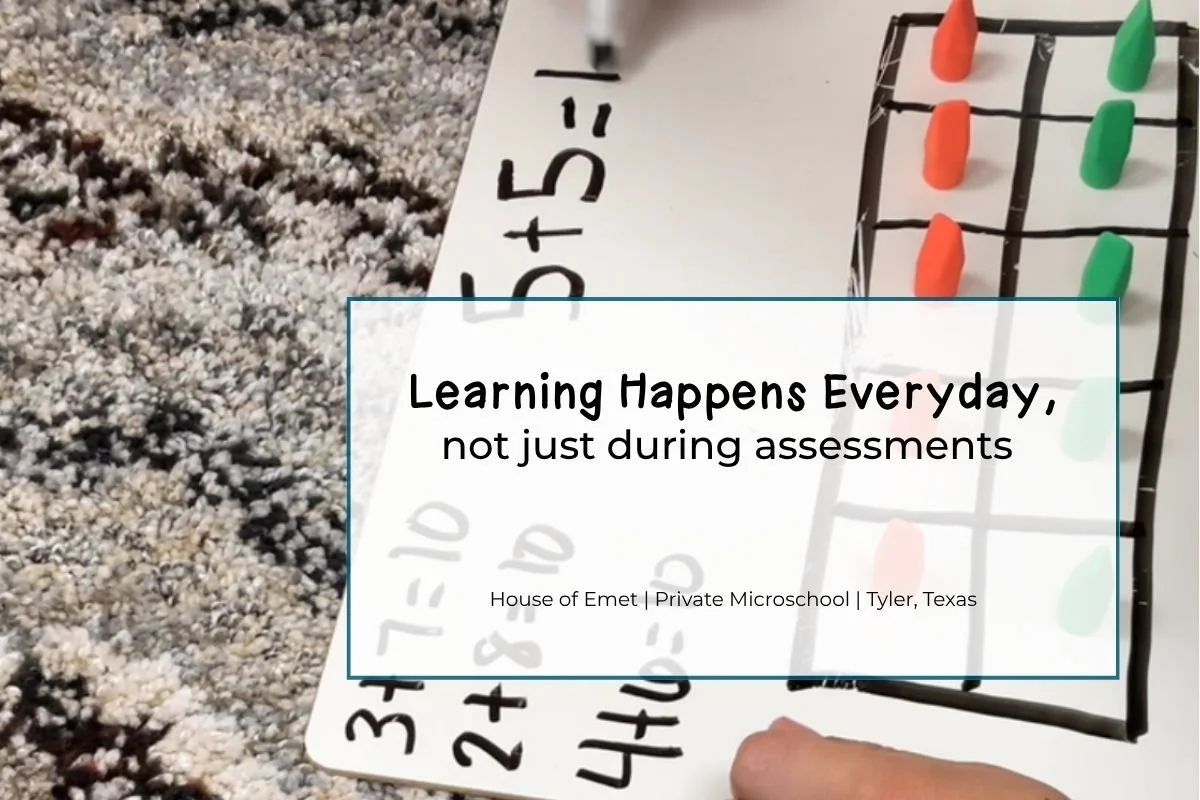
We measure growth through daily learning, not just testing days.
Student Work Tells a Story
Tests provide useful information, but they don't tell the whole story.
Student work often reveals just as much.
When I look at a student's writing portfolio, I can see growth.
When I compare math work from September to math work in May, I can see growth.
When I watch a child explain their thinking during a discussion, I can see growth.
Progress isn't measured by a single assignment.
It's measured through consistent evidence collected over time.
That's why we pay close attention to:
Daily assignments
Writing samples
Reading growth
Project work
Classroom discussions
Independent practice
Each piece helps us understand where a student is and where they're headed.
Students Learn to See Their Own Growth
One of my favorite things happens when students begin recognizing their own progress.
At the beginning of the year, some children focus almost entirely on what they can't do.
By the middle of the year, something starts to shift.
They begin noticing what they can do.
They realize they can read books that once felt impossible.
They solve math problems independently.
They write longer, stronger responses.
They ask deeper questions.
Confidence grows because growth becomes visible.
And when students can see their own progress, they become more motivated to continue learning.
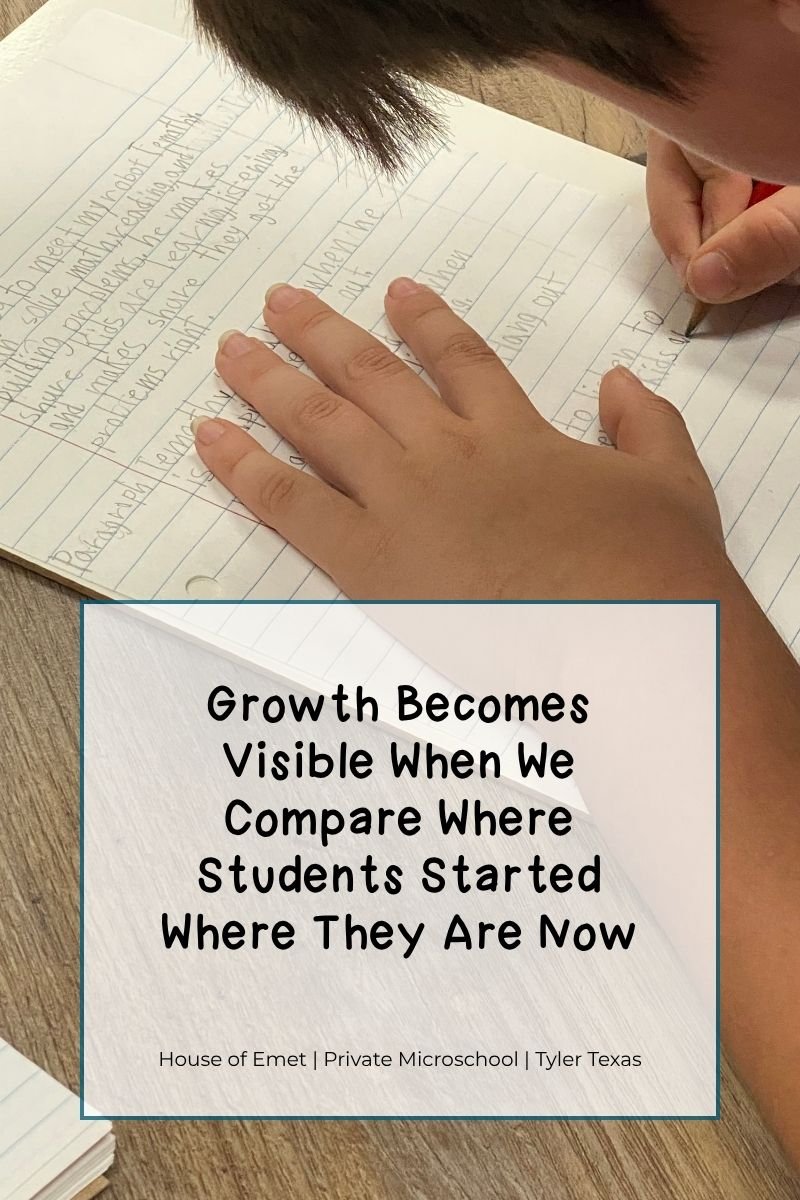
Student work tells a powerful story about progress and understanding.
We Set Goals and Monitor Progress Throughout the Year
Learning isn't something that simply happens to students.
We want children to become active participants in their growth.
Throughout the year, students work toward academic goals and receive support as they move forward.
Some goals may focus on reading.
Others may focus on writing, math, organization, or independence.
As educators, our job is to provide the instruction, support, and opportunities students need to make progress.
Then we continually monitor that progress and adjust when needed.
Because every child deserves a learning experience that meets them where they are.
Progress Is More Than a Test Score
At House of Emet, we absolutely care about academic growth.
We want students to become stronger readers, writers, mathematicians, and thinkers.
But we also recognize that progress isn't limited to academics.
Progress can look like:
A child who finally believes they can learn.
A student who asks for help when they need it.
A reluctant reader who begins picking up books voluntarily.
A child who learns to persevere through challenges.
A student who gains confidence in their own abilities.
Those things matter too.
Because education isn't simply about what children know.
It's about who they are becoming.
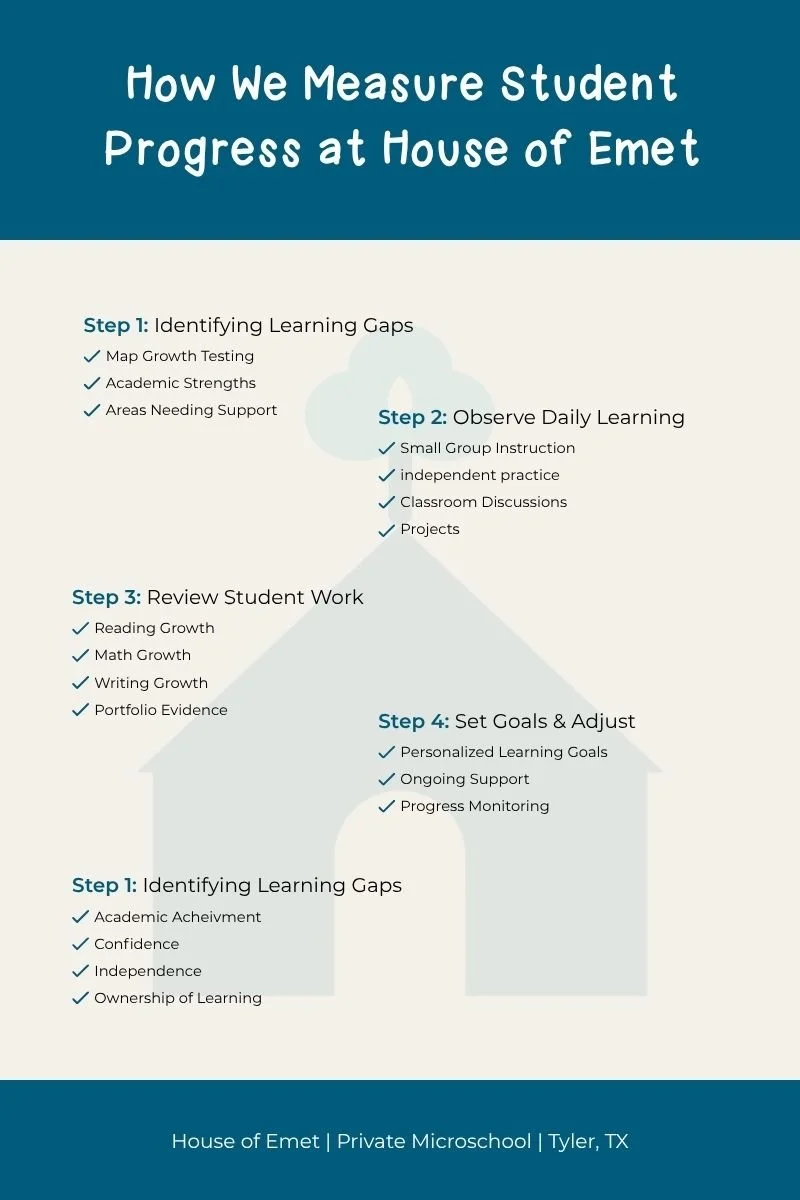
So, How Do We Measure Student Progress?
We use assessments to identify learning gaps.
We use daily instruction and observations to guide teaching.
We review student work to monitor growth.
We set goals and track progress throughout the year.
And we help students recognize the growth happening within themselves.
Because at House of Emet, our goal isn't simply to move students through a curriculum.
Our goal is to help them grow in knowledge, confidence, wisdom, and independence, one step at a time.
Frequently Asked Questions
How do microschools measure student progress?
Microschools use a combination of assessments, student work, observations, and ongoing progress monitoring to understand student growth.
What is MAP Growth testing?
MAP Growth is an assessment that helps educators identify learning gaps, academic strengths, and opportunities for growth.
How do you know if a child is making academic progress?
Progress can be measured through assessments, classroom performance, student work samples, projects, and growth toward learning goals.
Why is personalized learning important?
Personalized learning allows educators to meet students where they are academically and provide instruction based on their individual needs.
