
What You Need to Know Before Choosing a Microschool Like House of Emet
If you're exploring alternatives to traditional education, you've probably come across the term microschool. Maybe a friend mentioned one. Maybe you found one while researching private schools, homeschooling, or educational options for your child.
As interest in microschools continues to grow, so do the misconceptions.
Before choosing a microschool like House of Emet, it's important to understand what a microschool is—and what it isn't.
Microschools combine personalized learning, strong relationships, and small learning environments.
A Microschool Is Not a Charter School
One of the most common misconceptions is that a microschool is simply a smaller version of a charter school.
While all three models educate children, they operate very differently.
Charter schools typically serve larger groups of students and follow state requirements regarding curriculum, assessments, and operations.
Microschools are intentionally designed to be smaller and more flexible. Rather than building instruction around large groups of students, microschools are able to focus on the individual learners sitting in front of them.
This flexibility allows many microschools to incorporate approaches such as:
Project-based learning
Personalized instruction
Multi-age classrooms
Student-led learning opportunities
Smaller learning communities
At House of Emet, this flexibility allows us to focus on academic growth, student independence, and meaningful learning experiences while maintaining high expectations for every student.
Our educational approach allows students to learn through hands-on projects, individualized instruction, and meaningful academic experiences. Learn more about the Student Experience at House of Emet.
A Microschool Is Not Homeschooling or a Homeschool Co-op
Many parents initially assume that microschools are simply homeschool groups meeting together.
While microschools and homeschooling share some similarities, they are not the same thing.
In a homeschool setting, parents are typically responsible for selecting curriculum, delivering instruction, and overseeing their child's education.
In a homeschool co-op, families often work together to provide classes, activities, or enrichment opportunities.
A microschool is different.
At House of Emet:
Instruction is led by a professional educator.
Students attend school on a consistent schedule.
Academic planning and instruction are provided by the school.
Families pay tuition for educational services.
Parents partner with the school rather than serving as the primary instructor.
For many families, a microschool provides the personalized feel they appreciate about homeschooling while offering the structure and support of a school environment.
While both models offer flexibility, microschools provide professional instruction and structured learning environments.
Families Looking for Educational Options Often Value Flexibility
Every family's educational journey is unique.
Some families are searching because their child is struggling academically.
Sometimes the issue isn't academics at all. Sometimes a child simply needs a different environment. Read Is My Child Bored—Or Do They Need a Different School? if you're wondering whether your child's current school is still the right fit.
Others are looking for a smaller environment where their child can receive more individual attention.
Some simply believe there may be a better fit than the traditional model.
One reason families are drawn to microschools is flexibility.
Microschools have the ability to meet students where they are academically while still providing structure, accountability, and meaningful learning experiences.
Instead of asking every child to fit the same mold, microschools can often adapt instruction to support student growth.
This doesn't mean lowering expectations.
It means recognizing that children learn differently and providing the support they need to succeed.
Microschools Are Intentionally Small Learning Communities
Perhaps the defining characteristic of a microschool is its size.
Most microschools serve between 5 and 15 students in a learning community.
Compare that to many traditional classrooms, which may serve 20 to 30 students at a time.
At House of Emet, our intentionally small environment allows students to be truly known.
Teachers know:
Their strengths
Their challenges
Their interests
Their learning needs
Their growth over time
Students are not simply another name on a roster.
They become part of a learning community where relationships matter and every child is seen.
Small learning environments also create opportunities for:
More individualized instruction
Stronger teacher-student relationships
Meaningful collaboration
Leadership opportunities
Greater student engagement
For many families, this sense of community is one of the greatest benefits of a microschool education.
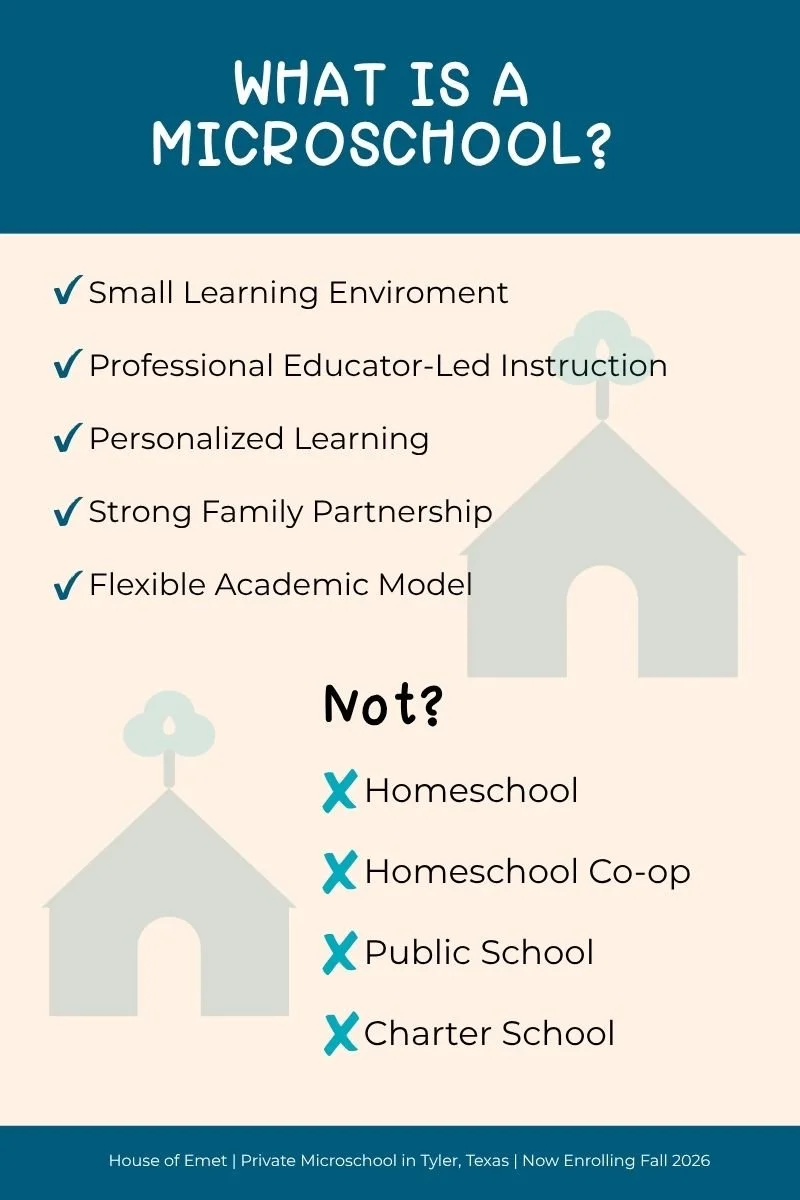
A quick overview of the key characteristics that make microschools unique.
Is a Microschool Right for Your Family?
Microschools are not designed to replace every educational option.
They are simply one option among many.
The best educational environment is the one that aligns with your child's needs, your family's values, and your educational goals.
If you're looking for:
A smaller learning environment
Personalized instruction
Strong relationships
Academic support tailored to your child
A balance of structure and flexibility
A school where your child is truly known
then a microschool may be worth exploring.
At House of Emet, we believe children thrive when they are known, challenged, supported, and given opportunities to grow in both wisdom and independence.
Because education isn't just about helping children pass a test.
It's about helping them become who they were created to be.
If you're considering a different educational path for your child, know that you're not alone. Many parents wrestle with the decision. You may also enjoy Why Parents Feel Guilty About Changing Schools (Even When They Know Something Isn't Working).
Ready to learn more?
In our next article, we'll answer one of the most common questions parents ask:
How do students actually learn in a multi-age microschool classroom? → Read Next
