
Freedom Without Responsibility Isn't Freedom: What We're Really Teaching at House of Emet
Every year around the Fourth of July, we talk a lot about freedom.
We celebrate it. We protect it. We teach our children about it.
But the older I get, the more I realize that freedom is one of the most misunderstood ideas in our culture.
Many people define freedom as being able to do whatever they want, whenever they want, however they want. Yet when I look at Scripture, and when I look at the children I serve, I see something different.
Real freedom isn't the absence of responsibility.
Real freedom is having the character to handle responsibility well.
That belief shapes nearly everything we do at House of Emet.If you're new to microschools and exploring different educational options, you may find it helpful to start with What You Need to Know Before Choosing a Microschool Like House of Emet.
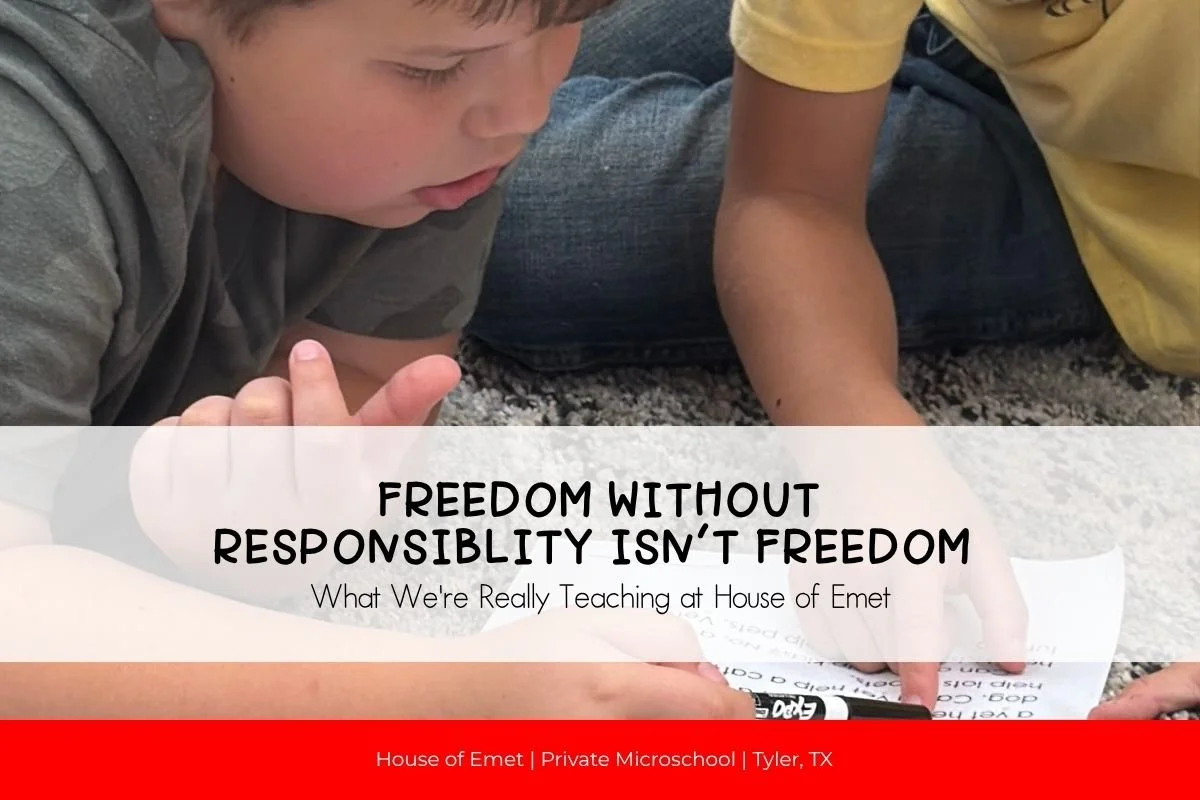
Real freedom grows when children learn responsibility, self-control, and ownership.
What Freedom Really Means
When I think about freedom, I don't think about having no rules.
I think about having the ability to live, learn, worship, and pursue God's calling without unnecessary bondage.
The Bible describes freedom as liberation from sin, not liberation from responsibility. In fact, Scripture repeatedly connects freedom with wisdom, self-control, service, and love.
Freedom is a gift.
But every gift comes with stewardship.
A child who has complete freedom without guidance often becomes overwhelmed.
A child who has complete control imposed on them never learns how to govern themselves.
The goal is neither chaos nor control.
The goal is maturity.
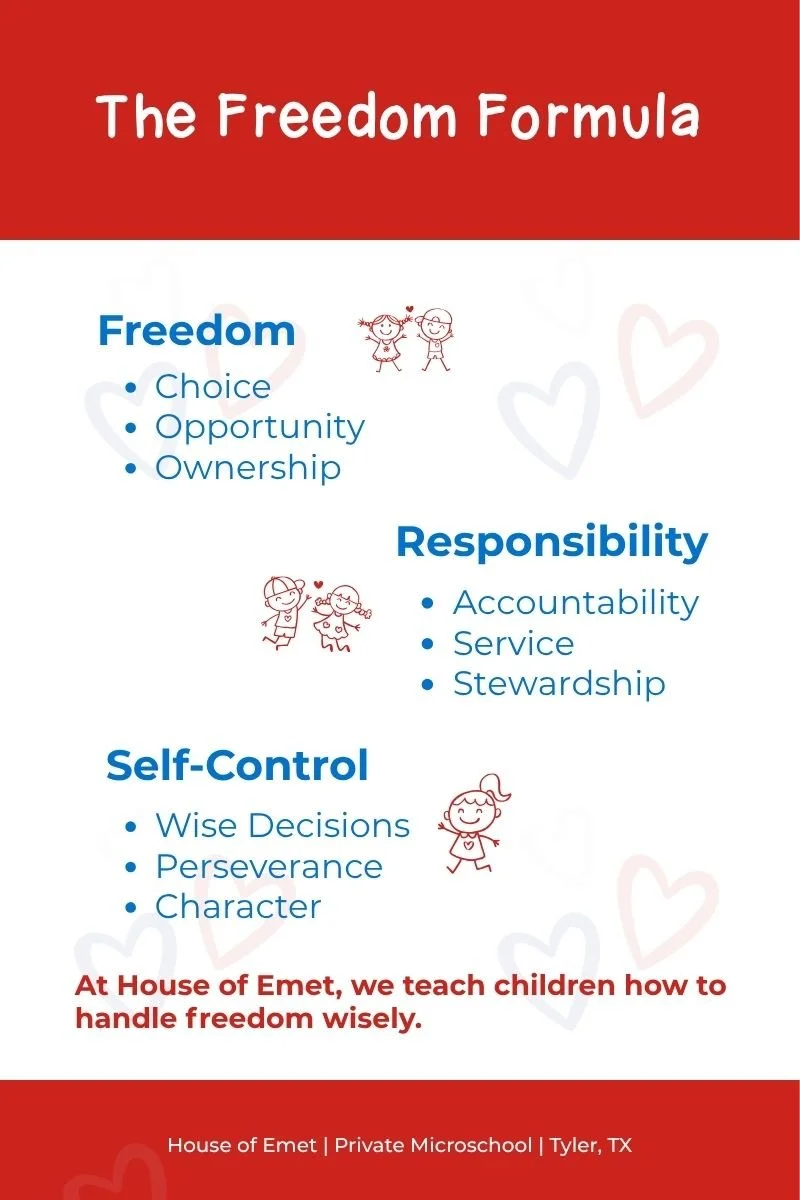
That's why when parents ask me what kind of environment House of Emet provides, I often tell them that we are intentionally teaching children how to handle freedom wisely.
Why Responsibility Matters So Much
One of the greatest gifts we can give children is responsibility. One reason many families begin exploring alternatives to traditional education is because they want their child to be known, challenged, and trusted with meaningful responsibility. If you're still trying to determine whether a smaller learning environment might be a good fit, I share several questions to consider in How Do I Know If a School Is Actually a Good Fit For My Child?
Not crushing responsibility.
Not adult-sized responsibility.
Age-appropriate responsibility.
Children are capable of far more than we sometimes realize.
They can contribute.
They can solve problems.
They can help others.
They can take ownership of their work.
They can learn from mistakes.
They can serve their community.
When children are never given responsibility, they often begin to doubt their own capability.
When children are trusted with responsibility, something powerful happens.
Confidence grows.
Competence grows.
Character grows.
Responsibility teaches children that their choices matter.
It teaches them that actions have consequences.
It teaches them that freedom and accountability belong together.
This is one reason why teaching responsibility to children is so important. We aren't simply preparing students for next week's assignment. We are preparing them for adulthood.
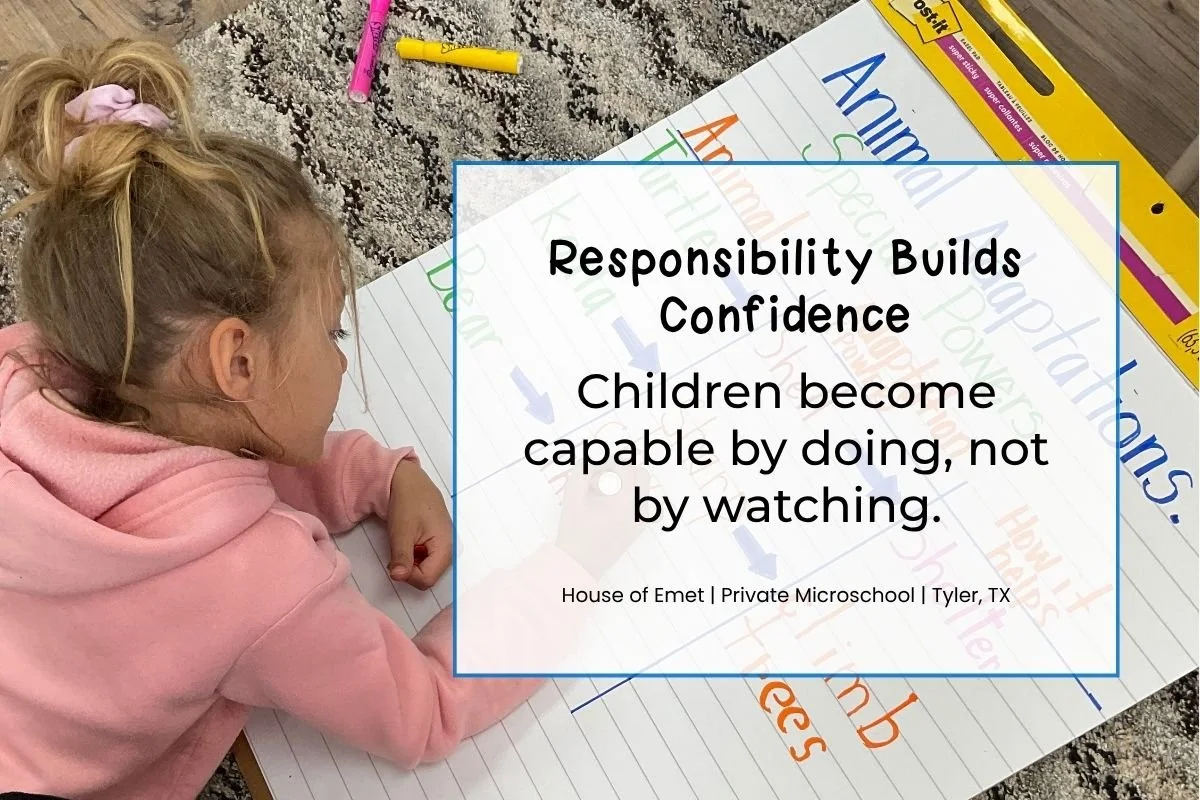
Responsibility helps children develop confidence, competence, and character.
The Missing Ingredient: Self-Control
If freedom and responsibility are close friends, self-control is the bridge that connects them.
A child may know the right thing to do.
A child may even want to do the right thing. This challenge often has less to do with intelligence and more to do with development, environment, and support. In fact, many parents discover that their child's struggles aren't always caused by the child themselves, but by a learning environment that isn't meeting their needs.
But without self-control, that knowledge rarely becomes action.
This is one reason our social-emotional learning focus centers on character development and the Fruit of the Spirit.
We want students to learn how to pause before reacting.
We want them to learn how to persevere through challenges.
We want them to learn how to manage frustration.
We want them to learn how to respond thoughtfully instead of impulsively.
Self-control isn't about creating perfect children.
It's about helping children develop the internal tools they need to navigate life successfully.
The truth is that freedom without self-control eventually becomes bondage.
But freedom paired with self-control creates opportunities for growth, leadership, and service.
What Independence Looks Like in Children
When people hear the phrase "independent learner," they sometimes imagine a child sitting quietly completing worksheets alone.
That's not what I mean.
An independent learner is a child who is gradually learning how to take ownership of their learning.
In a multi-age microschool environment, students often have more opportunities to develop ownership, leadership, and independence than they would in a traditional classroom. You can learn more about that process in How Students Actually Learn in a Multi-Age Microschool Classroom.
They ask questions.
They use available resources.
They manage materials.
They follow through on responsibilities.
They learn how to work through challenges instead of immediately giving up.
They understand that learning requires effort.
At House of Emet, independence is not something we expect children to magically develop.
It's something we intentionally teach.
Little by little.
Day by day.
Year by year.
Because one of the greatest goals of education is helping children become capable, confident, and responsible learners.
A Final Thought for Parents
If you're searching for a small private school, a Christian microschool, or an alternative education option in East Texas, you may be looking for more than strong academics.
You may be looking for a place where your child is known.
A place where your child is challenged.
A place where your child learns how to carry responsibility with confidence.
That's the culture we're building at House of Emet.
Not because children need more pressure.
But because they are capable of more than the world often expects from them.
And when freedom is paired with responsibility, children don't just learn.
They flourish.
Interested in learning more about House of Emet?
If you're exploring microschools in Tyler, Texas and wondering whether a smaller, relationship-centered learning environment might be a good fit for your child, I'd love to talk with you. Schedule a conversation and let's discuss your child's needs, strengths, and goals for the coming school year.
If you're still in the research stage, I recommend reading What You Need to Know Before Choosing a Microschool Like House of Emet and Is Microschool the Right Fit For Your Family? before scheduling a call. Those articles answer many of the questions parents ask during their first conversation with me.
Frequently Asked Questions
How do you teach responsibility to children?
Children learn responsibility by practicing it. We give students age-appropriate opportunities to make decisions, contribute to the classroom, complete meaningful work, and learn from mistakes. Responsibility grows through experience, not lectures.
Why is self-control important for students?
Self-control helps children stay focused, persevere through challenges, and make thoughtful decisions. It's one of the key skills that supports learning, healthy relationships, and long-term success both inside and outside the classroom.
Why is self-control important for students?
Self-control helps children stay focused, persevere through challenges, and make thoughtful decisions. It's one of the key skills that supports learning, healthy relationships, and long-term success both inside and outside the classroom.
What makes a microschool different from a traditional school?
Microschools are intentionally small, allowing for stronger relationships, individualized instruction, and greater flexibility. Students are known personally, and learning can be adapted to their needs rather than forcing every child into the same mold.
How do microschools encourage independent learning?
Microschools encourage independent learning by giving students opportunities to take ownership of their work, solve problems, and make decisions. With guidance and support, children gradually learn how to manage their learning with confidence.
