
Why Parents Feel Guilty About Changing Schools (Even When They Know Something Isn’t Working)
Let me tell you something I’ve heard from parents more times than I can count—usually said quietly, like they’re admitting something they’re not supposed to feel:
“I think my child needs something different… but I feel so guilty even thinking about changing schools.”
If that’s you, let me say this first—teacher to friend:
That guilt doesn’t mean you’re doing something wrong.
It usually means you’re trying to protect your child from something you remember all too well.
Why changing schools can feel emotionally heavy for parents—even when it’s done with care.
Where the Guilt Really Comes From
I’ll be honest with you.
One of the reasons I didn’t move my child from school (even when parts of it felt hard) was because of my own childhood.
As a kid, I didn’t stay at one elementary school for more than a year. Sometimes less. I was always the new kid. Always adjusting. Always starting over.
So when my child started elementary school, I made a quiet promise to myself:
“He’s not going to go through what I went through”
He stayed at the same elementary school from kindergarten through fifth grade. The only reason he changed middle schools was because our district rezoned students—not because I chose to move him.
Stability mattered to me. Deeply.
And I share that because many parents carry a similar weight
maybe not the same story, but the same desire to protect.
When Stability and Fit Start Pulling in Different Directions
Here’s where it gets complicated.
Stability is important.
Consistency matters.
Children benefit from roots.
But sometimes parents find themselves holding two truths at the same time:
I want my child to feel secure and settled.
I’m not sure this environment is helping them thrive anymore.
That tension… is where guilt lives.
Because changing schools can feel like breaking a promise
even when the promise was made out of love.
The Quiet Fears Under the Guilt
In my experience as a teacher, guilt usually isn’t about the school itself.
It’s about fear.
Parents worry:
“What if I make things worse?”
“What if this feels like instability to my child?”
“What if I’m projecting my own stuff?”
“What if I regret this later?”
Those aren’t careless thoughts.
They’re protective ones.
They tell me you’re not reacting—you’re weighing impact.
Guilt Doesn’t Mean You’re Being Disloyal
This part matters.
Choosing something different for your child doesn’t erase the good that came before. It doesn’t mean a school failed—or that you did.
It means you’re responding to where your child is now.
Children grow.
They need change.
What worked at one stage may not work at another.
That doesn’t make you inconsistent.
It makes you attentive.
Stability and fit are both important and sometimes parents must hold them together.
When “Staying” Starts to Cost More Than “Changing”
There’s a moment many parents reach, even if they don’t say it out loud.
They notice:
Their child is coping, but not flourishing
Confidence is shrinking
Learning feels heavier each year
Joy is being replaced by endurance
And at that point, staying put—just to avoid change—can begin to cost more than thoughtfully choosing something different.
That realization is heavy.
And guilt often shows up right on time.
A Reframe That Helped Me (And Many Parents)
Here’s the reframe I come back to often:
Stability isn’t just about staying.
It’s about feeling safe enough to grow.
Sometimes stability looks like continuity.
Sometimes it looks like adjusting the environment so your child can breathe again.
Neither choice is careless.
Both require wisdom.
You’re Allowed to Choose With Care, Not Pressure
You don’t have to rush.
You don’t have to decide today.
You don’t have to explain yourself to everyone.
You’re allowed to:
reflect honestly
separate your story from your child’s needs
gather information
move slowly and intentionally
Guilt doesn’t mean stop.
It often means… pause and discern.
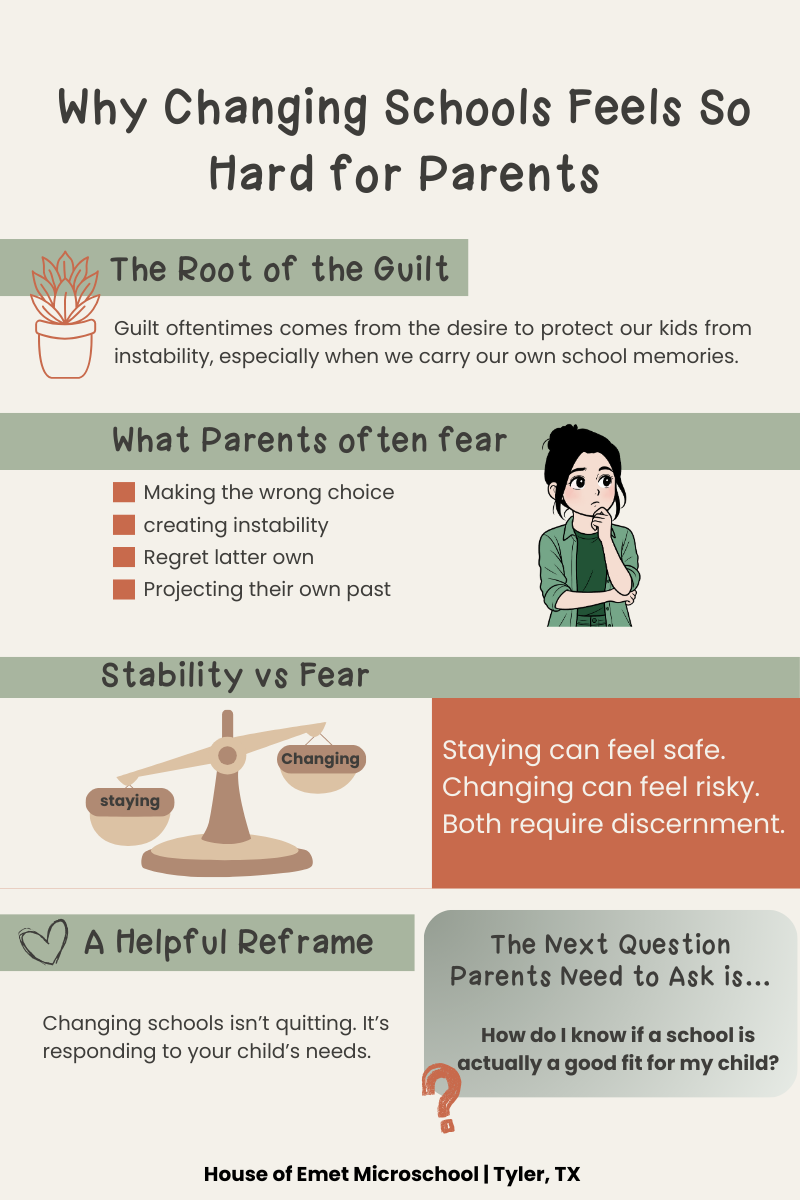
A simple breakdown of where school-change guilt comes from and how parents can reframe the decision.
The Question That Comes After the Guilt
Once parents work through the guilt, a new question usually surfaces:
“How do I know if a school is actually a good fit for my child?”
Not the most popular.
Not the most convenient.
But the one that matters most.
That’s what we’ll talk about next: how to recognize a good fit based on your child’s growth, confidence, and well-being, not just reputation or routine.
👉 Coming next: How to Know If a School Is Truly a Good Fit for Your Child
